


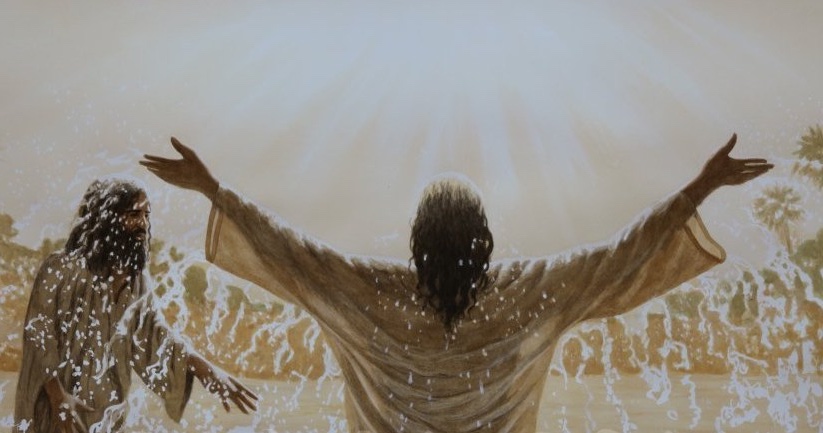
“In the fifteenth year of the reign of Tiberius Caesar, Pontius Pilate being governor of Judea, and Herod being tetrarch of Galilee, and his brother Philip tetrarch of the region of Ituraea and Trachonitis, and Lysanias tetrarch of Abilene, during the high priesthood of Annas and Caiaphas, the word of God came to John the son of Zechariah in the wilderness. And he went into all the region around the Jordan, proclaiming a baptism of repentance for the forgiveness of sins.”
Luke 3:1-3 ESV
Through the Bible: Matthew 3, Mark 1, Luke 3
Three of the four gospels have an account of Jesus being baptized. The one that doesn’t is John, and even John has John the Baptist’s testimony of seeing the Holy Spirit descend on Jesus (see John 1:32-33).
Of the three, Luke gives the fullest account of John’s message. He calls the people to repent (v. 3), warns them to bear fruit in keeping with repentance (v. 8), and when the crowds ask, “What shall we do?” he answers with concrete acts of justice and mercy:
- “Whoever has two tunics is to share with him who has none, and whoever has food is to do likewise.
- “Collect no more than you are authorized to do.”
- “Do not extort money from anyone by threats or by false accusation, and be content with your wages.”
Luke 3:10-14 ESV
John’s baptism seems centered on repentance and reform—on what people must do to be right with God. That’s the way most of us naturally think. If you’ve done wrong, fix it. If you’ve fallen, get up and do better. Work harder, clean up, prove yourself. Then, maybe, God will be pleased.
But then, Jesus steps into the water.
Matthew tells us John tried to stop Him: “I need to be baptized by You, and do You come to me?” (Matt 3:14). Why? Because Jesus had never sinned. He didn’t need cleansing.
But there’s more to it than that. John told his listeners that they needed to “produce fruit in keeping with repentance” (see Luke 3:8). So it’s not simply not sinning; it’s also doing good. In light of this, John could argue that Jesus also hadn’t done anything to earn baptism. He hadn’t given away a cloak, preached a sermon, faced a temptation, or healed a soul. John told his listeners to give away one of their tunics and to share their food. There’s no record in Scripture of Jesus having done any of these things up to that point.
In fact, there’s no record of Jesus having done anything at this point. He has yet to preach a sermon, or face a temptation, or heal anyone. All those come later.
At this point, all He had was who He was.
And yet…
21 Now when all the people were baptized, and when Jesus also had been baptized and was praying, the heavens were opened, 22 and the Holy Spirit descended on him in bodily form, like a dove; and a voice came from heaven, “You are my beloved Son;[c] with you I am well pleased.” (Luke 3:21-22)
Before He preached a single text.
Before He passed a single test.
Before He healed a single person.
Before He shed a drop of blood.
He had the approval of His heavenly Father. More than that, He had His delight.
Maybe that’s why Jesus was baptized: to show us that God’s delight isn’t earned by performance. It’s received through belonging.
Too many of us are like Apollos in Acts 18—zealous, moral, and sincere, but knowing only “the baptism of John.” All we know of faith is repent, behave, perform. We need to learn “the way of God more accurately”: that grace begins with the Father’s voice saying, You are my beloved child.
Centuries later, another John (Bunyan, of Pilgrim’s Progress fame) wrote this playful, yet profound little couplet:
Run John, Run! The Law commands,
Yet gives us neither feet nor hands.
A better word the Gospel brings:
It bids us fly, then gives us wings.
Rest today in your Father’s delight.
He is already well pleased with you.
This blog will always be a free resource for anyone who wants to grow in their love for God’s Word. If it has blessed you and you would like to support the ministry of 66in52, please consider a one time or recurring donation. Thank you!
Leave a ReplyCancel reply